 By admin
 Unveiling the Power of Map Keys in JavaScript
Related Articles: Unveiling the Power of Map Keys in JavaScript
Introduction
In this auspicious occasion, we are delighted to delve into the intriguing topic related to Unveiling the Power of Map Keys in JavaScript. Let’s weave interesting information and offer fresh perspectives to the readers.
Table of Content
- 1 Related Articles: Unveiling the Power of Map Keys in JavaScript
- 2 Introduction
- 3 Unveiling the Power of Map Keys in JavaScript
- 3.1 Understanding the Essence of Map Keys
- 3.2 Exploring the Advantages of Map Keys
- 3.3 Practical Applications of Map Keys
- 3.4 Understanding Map Key Operations
- 3.5 Iterating Over Map Keys
- 3.6 Illustrative Examples of Map Key Usage
- 3.7 FAQs Regarding Map Keys
- 3.8 Tips for Effective Map Key Usage
- 3.9 Conclusion
- 4 Closure
Unveiling the Power of Map Keys in JavaScript

The JavaScript Map object is a highly versatile data structure that enables efficient storage and retrieval of key-value pairs. Unlike traditional arrays, which use numeric indices, Map objects allow you to use any data type as keys, including strings, numbers, objects, and even functions. This flexibility makes them a powerful tool for various programming tasks.
Understanding the Essence of Map Keys
At the core of the Map object lies the concept of a "key." Each key acts as a unique identifier for its corresponding value. This relationship is crucial for retrieving specific data stored within the Map.
Imagine a dictionary where each word represents a key, and its definition is the associated value. You can quickly access a specific definition by knowing its corresponding word. Similarly, in a Map, you can efficiently retrieve a value by providing its unique key.
Exploring the Advantages of Map Keys
The ability to use any data type as keys unlocks numerous benefits, making Map objects a valuable asset in JavaScript development:
- Flexibility and Uniqueness: Keys can be strings, numbers, objects, or even functions, allowing for diverse data organization. Each key must be unique, ensuring that each value is associated with a single, unambiguous identifier.
-
Efficient Retrieval: The
get()method allows you to quickly retrieve the value associated with a specific key. This efficiency is crucial for applications requiring rapid data access. -
Dynamic Key Management: Keys can be added or removed from the
Mapdynamically, enabling flexible data manipulation. This dynamic nature makesMapobjects ideal for situations where data structures need to adapt to changing requirements. -
Ordered Key-Value Pairs:
Mapobjects maintain the insertion order of their key-value pairs, allowing for predictable iteration through the stored data. This order preservation is particularly useful for tasks involving sequence-dependent operations. -
Clear Data Representation:
Mapobjects provide a transparent and organized way to represent key-value relationships, enhancing code readability and maintainability.
Practical Applications of Map Keys
The versatility of Map keys makes them applicable to a wide range of JavaScript programming scenarios:
-
Storing User Preferences:
Mapobjects can effectively store user preferences, with keys representing preference categories (e.g., "theme," "language") and values representing the selected options. -
Caching Data:
Mapobjects can be used to cache frequently accessed data, with keys representing data identifiers and values representing the cached data itself. This can significantly improve application performance by reducing the need for repeated computations or database queries. -
Creating Lookup Tables:
Mapobjects can serve as efficient lookup tables, where keys represent identifiers and values represent corresponding data. This is useful for scenarios like mapping product IDs to their respective names or associating usernames with user profiles. -
Implementing Custom Data Structures:
Mapobjects can be used as building blocks for creating more complex data structures. For instance, a graph data structure can be implemented usingMapobjects to store nodes and their associated edges. -
Event Handling:
Mapobjects can be used to manage event listeners, with keys representing event types and values representing the functions to be executed when the corresponding event occurs.
Understanding Map Key Operations
Working with Map keys involves several core operations:
-
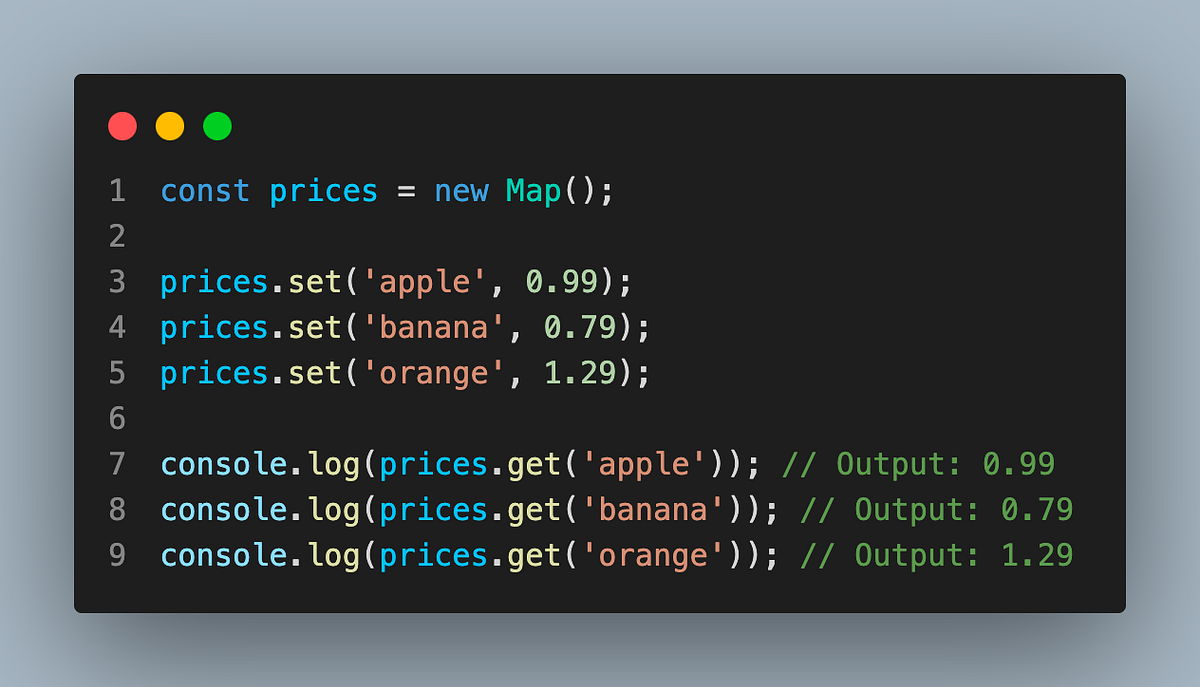
set(key, value): This method adds a new key-value pair to theMap. If the key already exists, its associated value is overwritten with the new value. -
get(key): This method retrieves the value associated with the provided key. If the key does not exist,undefinedis returned. -
has(key): This method checks whether a specific key exists in theMap. It returnstrueif the key exists andfalseotherwise. -
delete(key): This method removes the key-value pair associated with the provided key from theMap. -
clear(): This method removes all key-value pairs from theMap.
Iterating Over Map Keys
Map objects offer several methods for iterating over their key-value pairs:
-
forEach(callback): This method executes the provided callback function for each key-value pair in theMap. The callback function receives the value, key, and theMapobject as arguments. -
keys(): This method returns an iterator that yields each key in theMapin insertion order. -
values(): This method returns an iterator that yields each value in theMapin insertion order. -
entries(): This method returns an iterator that yields each key-value pair in theMapas an array, preserving insertion order.
Illustrative Examples of Map Key Usage
To solidify understanding, let’s explore practical examples of Map key usage:
Example 1: Storing User Preferences
const userPreferences = new Map();

userPreferences.set("theme", "dark");
userPreferences.set("language", "en");

console.log(userPreferences.get("theme")); // Output: "dark"

userPreferences.set("theme", "light"); // Overwrites existing value

console.log(userPreferences.get("theme")); // Output: "light"
Example 2: Implementing a Simple Cache
const dataCache = new Map();

function fetchData(url)
  if (dataCache.has(url))
    return dataCache.get(url);
   else
    const data = fetch(url).then(response => response.json());
    dataCache.set(url, data);
    return data;
Example 3: Creating a Lookup Table
const productLookup = new Map();

productLookup.set(123, "Laptop");
productLookup.set(456, "Smartphone");

console.log(productLookup.get(123)); // Output: "Laptop"
FAQs Regarding Map Keys
Q: What is the difference between a Map object and an object literal in JavaScript?
A: While both Map objects and object literals can store key-value pairs, they differ in key types and behavior:
-
Key Types:
Mapobjects allow any data type as keys, while object literals only accept strings as keys. -
Order Preservation:
Mapobjects maintain insertion order, while object literals do not guarantee order preservation. -
Dynamic Key Management:
Mapobjects allow dynamic addition and removal of key-value pairs, while object literals require modification through assignment operations.
Q: When should I use a Map object instead of an object literal?
A: Choose a Map object when:
- You need to use non-string keys (numbers, objects, functions).
- You require order preservation of key-value pairs.
- You need to dynamically add or remove key-value pairs.
Q: Can I use a Map object to store duplicate keys?
A: No, Map objects do not allow duplicate keys. If you attempt to add a key-value pair with an existing key, the existing value will be overwritten.
Tips for Effective Map Key Usage
- Choose Descriptive Keys: Select keys that clearly represent the associated values, improving code readability and maintainability.
- Use Consistent Key Naming Conventions: Adhere to consistent naming conventions for keys, enhancing code consistency and organization.
- Consider Key Performance: For frequently accessed keys, consider using primitive data types like strings or numbers, as they generally offer better performance than objects or functions.
-
Utilize
MapMethods Efficiently: Leverage the built-in methods likeget(),has(), anddelete()for efficient key-value pair manipulation.
Conclusion
The Map object in JavaScript provides a powerful and flexible way to store and retrieve key-value pairs. Its ability to use any data type as keys, combined with its efficient retrieval methods and dynamic key management capabilities, makes it a valuable tool for various programming tasks. By understanding the concepts and operations associated with Map keys, developers can effectively leverage this data structure to enhance their code’s functionality, efficiency, and readability.






Closure
Thus, we hope this article has provided valuable insights into Unveiling the Power of Map Keys in JavaScript. We appreciate your attention to our article. See you in our next article!